


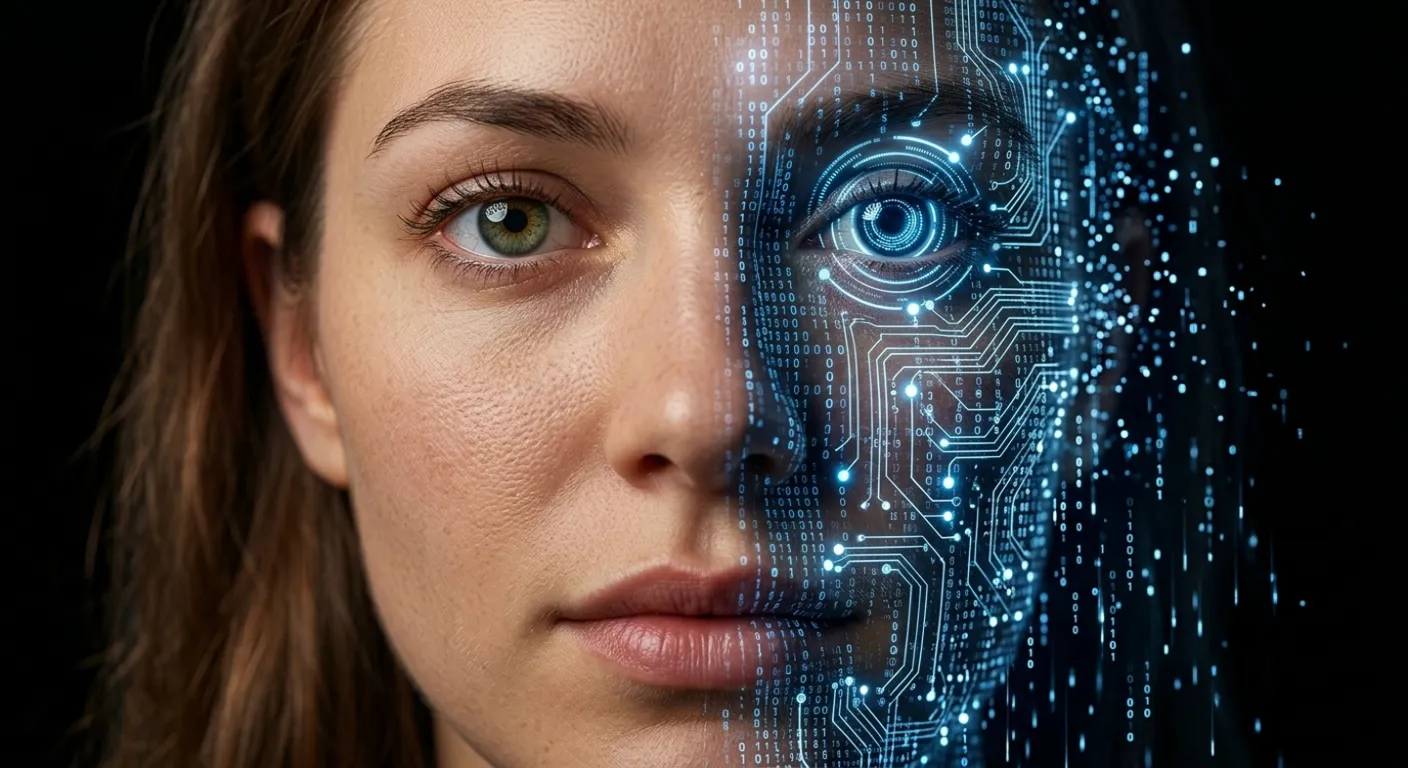
Why Comparisons Between AI and Human Intelligence Are Misleading
A balanced, deeply researched look at what AI can and cannot do, and why framing it as a rival to human cognition misses the point entirely.
Saturncube
13 March 2026
Every time a new AI system beats a human at chess, writes a persuasive essay, or passes a professional exam, the same headline appears: "AI is becoming smarter than us." It is a natural reaction. Humans have always measured the world against themselves, and when a machine does something we find difficult, the instinct is to rank it alongside us on some imaginary scale of intelligence.
But that instinct leads us astray. Comparing artificial intelligence with human intelligence is a bit like comparing a calculator with a philosopher. Both deal with numbers and logic in some sense, yet they operate on entirely different planes. The comparison is not just imprecise. It actively misleads us about what AI is, what it cannot do, and where its real value lies.
This article unpacks why that comparison persists, what the real differences are, and how a clearer mental model serves us far better than a rivalry framing.

Understanding What Artificial Intelligence Actually Is
Modern AI systems, particularly the large language models and deep learning networks making headlines today, are at their core extraordinarily sophisticated pattern matchers. They are trained on vast quantities of data: text, images, audio, code, and more. During training, mathematical models adjust billions of internal parameters until they can reliably predict outputs from inputs. The result is a system that can produce fluent text, identify objects in photographs, or recommend a product with impressive accuracy.
What AI systems do not do is understand in any meaningful sense. When a language model writes a paragraph about grief, it has not experienced loss. It has processed millions of texts written by humans who have, and it has learned which words tend to follow which other words in those contexts. The output can be moving and accurate. The process behind it is statistical, not experiential.
This distinction matters enormously. AI is fundamentally a tool engineered to solve specific classes of problems using data and computation. Its "intelligence" is real in the narrow sense that it performs tasks previously thought to require human cognition, but the mechanism is categorically different.
How Human Intelligence Works
Human cognition is not a single faculty. It is a dynamic, layered system shaped by evolution, culture, embodiment, emotion, and social experience. Psychologist Howard Gardner proposed that intelligence takes multiple distinct forms: linguistic, logical-mathematical, spatial, musical, interpersonal, and more. Cognitive scientists describe working memory, long-term memory, executive function, and metacognition as interacting systems. None of these operate in isolation.
Crucially, human intelligence is grounded in the physical world. We learn to walk before we learn to reason abstractly. We understand what "cold" means because we have shivered. We understand betrayal because we have trusted and been let down. Our cognition is deeply entangled with our bodies, our histories, and our relationships.
Human intelligence also features something that remains philosophically unresolved: consciousness. We have inner subjective experiences, what philosophers call qualia. We know what it is like to see red, to feel joy, to be bored. This first-person dimension of mind underpins our moral reasoning, our creativity, and our sense of purpose. No AI system possesses anything of the sort.
Why the AI vs Human Intelligence Comparison Became Popular
The comparison has several roots. The earliest AI researchers were explicit about it. Alan Turing, in his landmark 1950 paper, proposed a test of machine intelligence defined by whether a machine could pass as human in conversation. The framing was intentional: he wanted a concrete, measurable stand-in for the slippery concept of thinking. The "Turing Test" shaped public imagination for decades.
Science fiction amplified the idea further. From HAL 9000 to the Terminator to Samantha in Her, popular culture consistently depicted AI as either a mind like ours or a mind that would surpass ours. These narratives lodged deep in collective consciousness long before modern machine learning existed.
Media coverage of genuine AI milestones did the rest. When IBM's Deep Blue defeated Garry Kasparov in chess in 1997, and when DeepMind's AlphaGo beat the world's best Go player in 2016, the framing was almost always competitive: machine versus human. The wins felt symbolic. Journalists reached for the most resonant comparison available, which was human cognitive achievement.
The result is a deeply ingrained narrative that treats AI capability as a point on a single spectrum of intelligence shared with humans. That narrative is misleading.

Key Differences Between AI and Human Intelligence
The following differences illustrate why lumping AI and human cognition into the same category distorts our understanding of both:
Where AI Outperforms Humans
Within well-defined domains, AI systems genuinely exceed human capability. These strengths are real and worth taking seriously:
These are genuine capabilities. They are also capabilities that shine in specific, bounded, well-specified tasks, not in the open-ended, ambiguous terrain of real life.
Where Humans Still Have the Advantage
There are dimensions of cognition where the human advantage is not merely a matter of current technology being immature. They reflect something structurally different about what human intelligence is.
Creativity and genuine novelty. When we call AI creative, we usually mean it recombines existing patterns in surprising ways. Human creativity involves breaking from pattern entirely, conceiving of things that have no precedent. The conceptual leaps behind relativity, the structure of DNA, or the first novel were not recombinations of existing templates.
Emotional intelligence and empathy. Humans can feel what another person is experiencing and respond in kind. This is not simply a communication skill. It is grounded in shared vulnerability, embodiment, and consciousness. AI can simulate empathetic language; it cannot actually empathise.
Moral judgment. Ethics requires weighing competing values, understanding context, and accepting responsibility for consequences. These are acts of moral agency that presuppose consciousness, stakes, and the capacity to care. AI systems can apply ethical rules as programmed, but moral reasoning in genuinely novel dilemmas requires something AI does not have.
Open-ended learning and curiosity. Humans are intrinsically curious. We explore without a defined objective. A child learns language, physics, social rules, and moral reasoning from an extraordinarily sparse environment compared to what AI training requires, because human learning is driven by motivation, not data volume.
Human Intelligence vs Artificial Intelligence: A Comparison
Dimension | Human Intelligence | Artificial Intelligence |
|---|---|---|
Learning | Learns from experience, trial and error, emotion, and social context | Learns by processing labeled datasets and adjusting mathematical weights |
Adaptability | Adapts flexibly to entirely new situations using common sense | Struggles outside its trained domain; requires retraining for new tasks |
Speed | Slower at repetitive tasks; fatigues over time | Processes millions of data points in seconds without fatigue |
Creativity | Generates genuinely novel ideas driven by emotion and intuition | Recombines patterns from training data; does not originate ideas |
Consciousness | Self-aware with subjective inner experience | No consciousness, self-awareness, or subjective experience |
Emotional Understanding | Deeply understands and feels emotions; uses them in reasoning | Detects emotional patterns in text or voice but does not feel anything |
Common Sense | Applies intuitive reasoning to everyday situations effortlessly | Frequently fails on simple real-world problems requiring context |
Energy Use | Runs on roughly 20 watts (the human brain) | Large models require megawatts of computing infrastructure |
Error Handling | Recognises mistakes through reflection and context | Can confidently produce plausible-sounding wrong answers |
A Narrow Slice of Humanity New
One of the most overlooked problems with comparing AI to human intelligence is the question of whose intelligence AI was actually trained on. The datasets used to build large AI systems are not a balanced representation of all human knowledge, language, and culture. They are drawn heavily from English-language internet content, which itself skews toward Western, educated, and relatively affluent populations.
This means that when an AI system appears to "think," it is in many ways reflecting the assumptions, values, and framings of a narrow demographic slice of humanity. Languages spoken by hundreds of millions of people are dramatically underrepresented. Indigenous knowledge systems, oral traditions, and non-Western ways of reasoning are largely absent. The cognitive diversity that actually characterises human intelligence across cultures and communities is compressed into a much thinner profile.
So when we ask whether AI matches human intelligence, we should also ask: which humans? The gap between what AI has learned and the full breadth of human cognitive and cultural experience is far wider than benchmark test scores suggest.

The Limits of Scaling New
A popular assumption in AI research and media coverage is that intelligence is essentially a matter of scale. Give a model more data, more compute, and more parameters, and it will keep getting smarter. For certain tasks, this has proven true. But the assumption that scaling alone leads to general intelligence is increasingly contested, and for good reason.
There are things that more data simply cannot fix. An AI system trained on every text ever written still lacks a body, still has no causal understanding of the physical world, and still cannot form genuine intentions. These are not problems that disappear with a larger model. They are architectural limitations rooted in the fundamental nature of how current AI systems are built.
Human children develop rich, flexible intelligence on remarkably little data compared to what AI requires, because their learning is grounded in physical interaction, social feedback, curiosity, and motivation. The efficiency gap between human and AI learning points to something deeper than a resource difference. It points to a difference in the kind of system doing the learning. Scaling makes AI systems more capable within their existing architecture. It does not make them a different kind of thing.
Why the Comparison Can Be Misleading
Framing AI as a form of intelligence comparable to human intelligence does not just create a philosophical disagreement. It creates four very real, practical problems.
It inflates expectations When people believe AI thinks like a human, they trust it in areas where it is unreliable. Autonomous decisions about bail, medical treatment, or financial risk require careful human oversight, but that oversight gets skipped when the system is perceived as intelligent in a human sense. | It deflates appropriate appreciation The genuine things AI does brilliantly, such as rapid pattern recognition, tireless computation, and scaling information retrieval, get underappreciated when the comparison is always to some ideal of general intelligence that AI is supposedly approaching but has not yet reached. |
It frames a tool as a competitor A hammer does not compete with a carpenter. Neither does AI compete with human cognition. It extends and amplifies it. The competitive framing generates anxiety where there should be curiosity, and suspicion where there should be design thinking. | It muddies the hard problems Questions about AI consciousness, moral status, and rights are serious philosophical questions worth taking seriously, but only if framed correctly. Assuming AI is on a path to human-like intelligence leads us to ask the wrong questions and miss the genuinely difficult ones. |
A Better Way to Think About AI and Humans
A more accurate and productive framing treats AI as a new category of cognitive tool rather than a new category of mind. Just as writing extended human memory, mathematics extended human reasoning, and microscopes extended human perception, AI extends our capacity to process information and recognise patterns at scales we could not previously reach.
This framing has practical implications. It suggests we should ask not "will AI replace humans?" but rather "what does the combination of human judgment and AI processing capability allow us to do that neither could do alone?" The answers are genuinely exciting. Doctors using AI imaging tools detect diseases earlier. Researchers using AI to screen compounds accelerate drug discovery. Teachers using adaptive learning tools reach students at precisely the moment they need support.
In each case, the human brings what AI lacks: judgment, context, ethics, accountability, and genuine understanding. The AI brings what humans lack in those scenarios: speed, scale, and pattern recognition across enormous datasets. Neither is a replacement. Both are essential.
The more we shed the competitive framing, the more clearly we can design systems that are actually useful and genuinely safe. We can ask better questions about where human oversight is necessary, where AI should be trusted, and where the combination creates risks that neither party alone would create.

Frequently Asked Questions
1. Why do people compare AI with human intelligence?
Because AI systems perform tasks, such as playing chess, writing essays, and diagnosing diseases, that we previously associated exclusively with human cognition. When a machine does something only people used to do, the natural reflex is to place it on the same scale. The comparison is intuitive but imprecise, because the mechanism behind AI performance is fundamentally different from the mechanism behind human performance.
2. Is AI smarter than humans?
In specific, well-defined tasks, AI systems outperform the best humans. A chess engine will beat any grandmaster. An image recognition model will spot certain tumours in scans more reliably than a radiologist. But in open-ended situations requiring common sense, adaptability, moral reasoning, and genuine understanding, humans are not even close to being matched. "Smart" is not a single axis. The question itself is part of the problem.
3. Can AI think like humans?
No, at least not in any meaningful sense. AI systems process inputs and generate outputs through mathematical operations on numerical representations. There is no internal experience, no understanding, and no intentionality. When a language model produces a deeply moving piece of writing, it is the output of a statistical process trained on human expression. The appearance of thought is not the same as thought.
4. Will AI ever develop consciousness?
This is one of the genuinely open questions in philosophy and cognitive science. We do not have a complete theory of what generates consciousness in biological systems, which makes it very difficult to say whether artificial systems could develop it. Most researchers working in AI today do not believe current architectures produce or will produce consciousness. Whether future architectures could remains an open and important question, one worth pursuing carefully and without premature assumptions in either direction.
5. What is the biggest limitation of AI?
The absence of genuine understanding. AI systems can produce outputs that look like understanding without any underlying comprehension of meaning, context, or consequence. This brittleness, the tendency to fail in ways that reveal the absence of real understanding, is the deepest structural limitation. It means AI systems require careful human oversight in any domain where errors have real consequences, and it explains why even impressive AI performances exist alongside surprising, sometimes embarrassing failures.
Conclusion
The comparison between AI and human intelligence is understandable, historically rooted, and culturally persistent. It is also, at its core, misleading. The two operate through entirely different mechanisms, serve entirely different functions, and possess entirely different capabilities and limitations.
AI is a powerful, genuinely useful category of cognitive tool. Human intelligence is something far stranger, richer, and harder to define. It is embodied, emotional, conscious, and morally capable in ways that no current AI approaches. Recognising that distinction does not diminish AI. It clarifies what AI actually is and what we can reasonably expect from it.
The most productive question is not who wins the contest between human and machine intelligence. It is how we design the collaboration between them in ways that are honest about what each brings, careful about the risks, and ambitious about the genuine possibilities. That question is worth far more of our attention than the imaginary rivalry.