


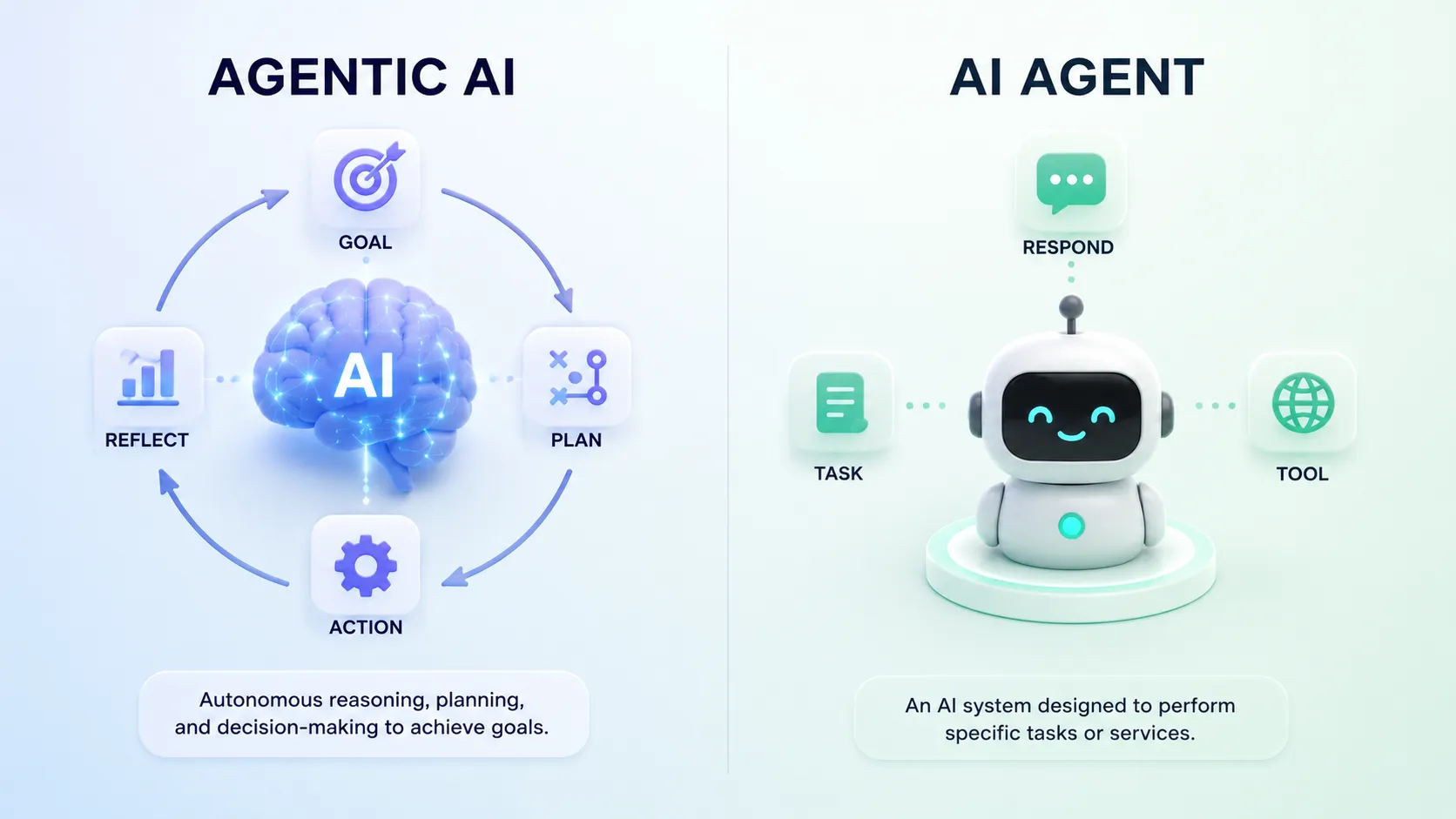
Agentic AI vs AI Agents
Agentic AI and AI agents are not the same thing. Understanding the difference helps businesses make smarter decisions about which AI approach actually fits their goals.
Saturncube
15 May 2026
If you have spent any time reading about AI in 2026, you have almost certainly seen both terms used. Agentic AI. AI agents. Sometimes in the same sentence, sometimes as if they mean the same thing. They do not. And the difference matters a lot if you are a business trying to figure out what kind of AI system you actually need.
This article breaks down exactly what each term means, where they overlap, where they differ, and which one is right for the problems your business is trying to solve. Confused about the terminology? You're not alone. Our AI development consultants can help you choose the right approach for your business.
Before getting into the comparison, it helps to understand what each term is describing on its own.

An AI agent is a software system built to take action. It receives a goal or an instruction, decides what steps to take, uses tools to execute those steps, and produces an output. A simple AI agent might monitor your email inbox for a specific type of message and reply automatically when one arrives. A more complex one might research a topic across multiple websites, summarize findings, and send a briefing to your team.
Agentic AI is not a specific system. It is a design philosophy. When people say a system is agentic, they mean it is built to operate with a high degree of autonomy, make decisions over multiple steps, pursue goals without being hand-held through every stage, and adapt when things do not go as expected.
The clearest way to put it: every AI agent is built using agentic principles, but not every system described as agentic AI is a standalone agent. Agentic AI is the approach. AI agents are the things you build using that approach.
Our service: Web Development
The two terms get mixed up for a simple reason: they evolved at the same time and the industry never settled on clean definitions before both became widely used.
A few years ago, most AI tools were reactive. You typed a prompt. You got a response. The conversation was one turn at a time, and nothing happened unless you asked for it. That was not agentic. It was a very capable autocomplete system.
The shift toward agentic thinking happened when developers started building systems that could chain multiple steps together, use external tools like search engines, calculators, and databases, remember context across a session, and take actions that had real-world consequences. Once that became possible, two things emerged: the concept of agentic AI as a paradigm, and AI agents as the practical implementations of that paradigm.
AI Agents | Agentic AI | |
|---|---|---|
What it is | A specific system built to complete tasks | A design philosophy or approach to building AI |
Operates how | Independently, pursuing a defined goal | Autonomously, across multiple steps and decisions |
Examples | KYC screening agent, meeting prep agent, customer support bot | A workflow where multiple agents collaborate under one orchestrating system |
Scope | Usually designed for one domain or job | Can describe single agents or multi-agent systems |
Built for | Executing tasks with minimal human input | Operating goals that require judgment, planning, and adaptation |
Human involvement | Low to none once deployed | Ranges from fully autonomous to human-in-the-loop depending on design |
The table above shows the practical split. An AI agent is what a developer builds and deploys. Agentic AI is how that developer is thinking about the problem.
Suppose a financial services firm wants to speed up its KYC compliance process.
An AI agent approach would look like this: build a specific agent that pulls KYC documents from the intake system, reads through them, checks names against sanctions databases, flags discrepancies, and prepares a compliance package for human review. That agent has a defined job. It does that job on every new case without being asked.
An agentic AI system for the same firm might go further. One agent handles document extraction. Another handles sanctions screening. A third handles risk scoring. An orchestrating layer coordinates all three, decides when to escalate to a human, and logs every decision for the audit trail. The whole system operates autonomously across thousands of cases simultaneously. Each component is an AI agent. The design that connects and coordinates them is agentic AI architecture.
Understanding the difference changes how you approach AI adoption. Businesses that treat every AI system as just another agent tend to underestimate what is required to build something that actually works at scale. Businesses that get lost in abstract definitions of agentic AI tend to overthink things before they have even shipped their first use case.
The practical approach is to start by identifying the specific task or workflow you want to improve, build or deploy an AI agent for that task first, and then expand toward agentic AI architecture once you understand what your agents need to do and how they need to interact.
Most businesses that have successfully deployed AI in 2026 started with a single well-scoped agent, learned from it, and then built toward more connected, autonomous systems over time. That progression is more reliable than trying to architect a full agentic system from day one without operational experience.
Agentic AI is also reshaping how software products are built, not just how internal workflows operate. Developers are now building applications where AI agents are part of the core product experience, not just a feature bolted on afterward.
A project management tool might include an agent that automatically updates task status based on team activity. A CRM might have an agent who prepares account summaries before every sales call. A logistics platform might run an agent that reroutes shipments when delays are detected. In each case, the agent is embedded into the product itself, and the product is described as agentic because it acts on behalf of users without waiting for manual input.
This trend is creating a real shift in what businesses expect from software. Tools that require users to do the same repetitive tasks manually are increasingly being replaced by tools that can handle those tasks autonomously. That raises the bar for any new product being built today.

What This Means If You Are Building AI Into Your Business
Whether you are looking at AI agents, agentic AI architecture, or both, a few things hold true across the board.
The quality of your data matters more than the quality of your AI model. An agent working with clean, well-organized data will consistently outperform a more sophisticated model working with messy inputs.
Security and auditability are not optional. Any agent taking actions in a production environment needs proper access controls, logging, and human review points at the right stages. This is especially important in regulated industries.
Starting small and expanding works better than building everything at once. One well-functioning agent that solves a real problem is more valuable than a complex multi-agent system that never gets deployed because it was too ambitious to ship.
At Saturncube Technologies, we have been building AI agents and agentic AI systems since 2014, across healthcare, finance, e-commerce, and SaaS. Whether your starting point is a single workflow agent or a full multi-agent architecture, our team helps you design, build, and deploy AI that fits your actual operations rather than a theoretical framework.
If you are evaluating which AI system your business needs, talk to our team. We can help you identify where a focused AI agent solves the problem today and where an agentic system makes sense as you scale.
Frequently Asked Questions
What is the difference between Agentic AI and AI agents?
AI agents are specific software systems designed to perform tasks autonomously, such as answering customer questions, qualifying leads, or processing documents. Agentic AI is the broader approach or architecture that enables AI systems to plan, reason, make decisions, and coordinate actions across multiple steps or agents.
Can a business use AI agents without implementing a full Agentic AI system?
Yes. Many businesses start with a single AI agent focused on a specific task, such as customer support, lead qualification, or workflow automation. As requirements grow, multiple AI agents can be connected into a larger agentic AI architecture.
What are some real-world examples of AI agents?
Common examples include customer support agents, AI sales assistants, appointment scheduling agents, compliance monitoring systems, document processing agents, and research assistants that gather and summarize information automatically.
When should a business consider Agentic AI instead of a single AI agent?
Agentic AI becomes valuable when multiple workflows, departments, or decision-making processes need to work together. Businesses managing complex operations, large volumes of data, or multi-step processes often benefit from an agentic AI architecture that coordinates multiple AI agents.
Are AI agents suitable for small and medium-sized businesses?
Absolutely. AI agents can help businesses automate repetitive tasks, improve response times, reduce operational costs, and increase productivity. Many organizations begin with a single AI agent before expanding to more advanced AI-powered systems.
How do AI agents and Agentic AI improve business operations?
They help automate routine tasks, analyze information faster, support decision-making, improve customer experiences, reduce manual workload, and enable teams to focus on higher-value activities. This can lead to improved efficiency, scalability, and operational performance.
Ready to Build Your AI Agent?
Our AI development team has built 50+ AI agents for businesses across healthcare, e-commerce, and SaaS. From concept to deployment, we handle everything.
Explore AI Development Services
Related Articles: